Vendredi 17 Décembre 2010
9 h 45 salle des actes CEAT
Post-doc
Laboratoire d'Informatique pour la Mécanique et les Sciences de l'Ingénieur
Invité par P. Jordan
Les phénomènes non-linéaires présents dans les systèmes thermoacoustiques sont responsables de l'apparition des écoulements continus secondaires qui se superposent aux oscillations acoustiques dominantes, pénalisant l'efficacité des systèmes. L'objectif de cette étude est de caractériser le champ acoustique dans un résonateur contenant un générateur d'onde thermoacoustique et de mettre en évidence les écoulements secondaires. Nous mesurons le champ de vitesse par vélocimétrie par images de particules (PIV). Les premières mesures enregistrées sans relation de phases avec la période acoustique, permettent de reconstruire la composante acoustique sur une période, en réordonnant les vitesses suivant leur phase avec une technique de projection par décomposition aux valeurs singulières (BK85). Celle-ci fait partie d'une batterie de post-traitements qui permettent d'obtenir des résultats concordant avec l'acoustique linéaire. Ils mettent en évidence un contenu harmonique important et le caractère non-linéaire de l'écoulement acoustique. Le calcul du champ de vitesse moyenné en temps montre l'existence d'un écoulement continu différent de celui de Rayleigh-Schlichting. Dans la fenêtre de mesure, il est composé de cellules de convection dont l'extension radiale tend à croître avec le rapport moteur. Il fait aussi apparaître un caractère tridimensionnel. Un deuxième type de mesures PIV synchronisées aux mesures de pression, apporte un complément d'information sur les écoulements secondaires et confirme globalement les résultats obtenus à partir des premières mesures. Cependant ces mesures synchronisées se révèlent moins précises que les premières. Je montrerai aussi que la POD peut aider à séparer le champ moyen des fluctuations acoustiques dans ce cas d'étude. Je finirai par quelques menues contributions à l'étude de l'écoulement affleurant une cavité et circulant autour d'une plaque épaisse.
Vendredi 10 Décembre 2010
11 h 00 salle de réunion LEA/SP2MI
Emmanuel MIGNOT et Nicolas RIVIERE
Mdc INSA et Prof. INSA
Laboratoire de Mécanique des Fluides et d'Acoustique
Invité par L. David
L'objectif de l'étude est de mesurer l'impact d'un obstacle émergeant positionné au sein d'un écoulement uniforme d'eau en régime torrentiel. A l'amont de l'obstacle, deux structures d'écoulement apparaissent : i) un ressaut hydraulique dans la zone proche de la surface libre, dû au ralentissement de l'écoulement et son passage en régime fluvial et ii) un tourbillon en fer à cheval à proximité du fond au pied de l'obstacle. Ces deux structures sont détachées à l'amont de l'obstacle et il apparaît qu'en fonction du régime d'écoulement (turbulent ou laminaire), deux formes d'écoulement sont observées. Nous nous attacherons à décrire la forme d'écoulement observé en régime turbulent, pour laquelle le détachement du ressaut a lieu à l'amont du détachement initiant le tourbillon en fer à cheval. La technique expérimentale utilisée consiste à introduire de la peinture sur le fond du canal et photographier les trajectoires qui transportent cette peinture. Par analyse d'image il est alors possible de détecter la courbe du pied du ressaut et du pied du tourbillon en fer à cheval. Les formes prises par ces courbes correspondent alors à une hyperbole pour le ressaut et une ellipse pour le tourbillon en fer à cheval donc il est possible d'identifier les paramètres. Un modèle analytique inspiré d'anciens travaux en aérodynamique (Moeckel, 1949) est finalement mis en place afin de prédire la distance de détachement du ressaut et montre les capacités et limites d'une telle approche.
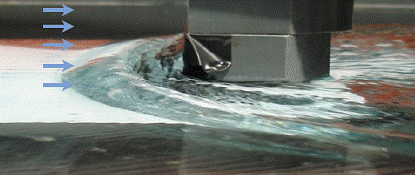
Légende de la figure : Chabardes (2007).
Vendredi 3 Décembre 2010
14 h 15 salle de réunion LEA/SP2MI
Senior Lecturer
School of Engineering and Information Technology
The University of New South Wales at ADFA
Canberra ACT Australia
Invité par B. Noack
Recently, a conditional, local derivation of the Maximum Entropy Production (MaxEP) principle has been presented based on Jaynes' maximum entropy (MaxEnt) method, using an entropy defined on the fluxes through an infinitesimal element of a flow system. The analysis is analogous to Gibbs' formulation of equilibrium thermodynamics, which expresses the balance between changes in entropy inside and outside a system, but is formulated for a non-equilibrium flow system. The MaxEP principle emerges as the extremum condition in some circumstances. In this seminar, a generic form of the derivation is first provided, encompassing seemingly disparate formulations of equilibrium thermodynamics, local steady-state flow and global steady-state flow (and other systems). The implications of the analysis are explored for several systems, including (i) the transition between laminar and turbulent flow in a pipe, and (ii) the modelling of planetary climate systems, including solar and extrasolar planets.
Jeudi 28 Octobre 2010
14 h 00 salle de réunion LEA/SP2MI
Researcher
Laboratoire de Mécanique de Lille
Ecole Centrale de Lille
Invité par J. Delville
We have developed a novel technique for the simultaneous measurement of the fluctuating velocity and pressure. Several different shapes of the probes shown below are manufactured, e.g., the needle-type fluctuating static pressure probe, the fluctuating total pressure probe and the disk-type fluctuating static pressure probe. The pressure probe is applied with the hot-wire sensor for the velocity-pressure simultaneous measurement. Experiments have been performed in a turbulent mixing layer, a wing-tip vortex flow, and the flow inside co-rotating disks. We carefully chose the appropriate pressure probe depending on the flow characteristics. The spatial distributions of the pressure statistics, e.g., the pressure fluctuations and the velocity-pressure correlation are measured and the contribution of the pressure-terms in the balance of the turbulent kinetic energy / the Reynolds stress equation is investigated.
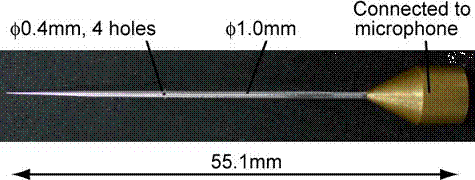
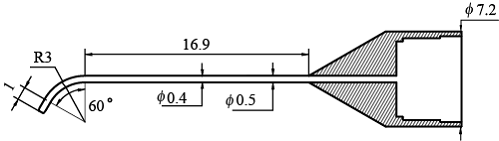
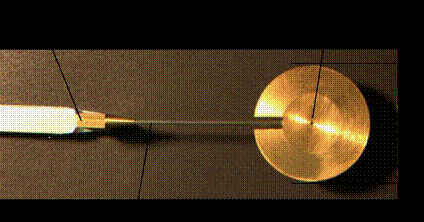
Légende de la figure : The probes for the fluctuating pressure measurement; (top) the needle-type static pressure probe, (middle) the bent-type total pressure probe, (bottom) the disk-type static pressure probe.
Jeudi 4 Novembre 2010
14 h 00 salle de réunion LEA/SP2MI
Researcher supported by "Royal Society University Research Fellowship"
1. Moscow Institute of Nuclear Safety RAS, Moscow, Russia
2. University of Cambridge, Dept Engineering Institute of Fluid Mechanics and Engineering Acoustics
Invité par P. Jordan
The mathematical modelling of aeroacoustic problems has a number of challenges associated with a few orders of magnitude difference between the space-time flow scales that are typical of the aerodynamic and the acoustic fields. In a number of cases there is no strong feedback loop between the linear acoustics and the nonlinear field. Then some form of the flow decomposition into the source and propagation, e.g., based on the Lighthill acoustic analogy, can be used to efficiently compute the far-field sound. One of such schemes is based on the Ffowcs Williams - Hawkings (FWH) method that is typically used in the porous formulation and neglecting all sound sources outside the numerical control surface. In this talk, we will provide an example of the numerically consistent implementation of the FWH approach for a shock-impulsive helicopter noise problem. A valuable feature of this numerical model is that its coarse grid predictions are independent of the numerical FWH surface. The classical FWH approach is known to be less efficient for capturing the sound of distributed noise sources, e.g., for jet noise. In these situations alternative forms of the acoustic analogy may be used. One example is the Goldstein-type acoustic analogy based on the linearised Euler equations and the nonlinear sound sources represented by the fluctuating Reynolds stresses. We will show that such methods can not only give accurate jet noise spectra predictions for a range of frequencies and observer angles but also allow one to do the "numerical beamforming" to identify the effective noise sources in the jet. For an accurate identification of effective sound sources in the jet, we will see that both source and propagation modelling is crucially important. The performance of any computational sound prediction scheme depends on the accuracy of the numerical algorithm used for aeroacoustic modelling. Hence, next we will discuss the important numerical properties that a computational method in the space-time domain has to possess in order to be suitable for computational aeroacoustics. Ideally, these should not only have the conservation, low dissipation and dispersion properties but also the vortex preservation capability. An example of the candidate numerical method that satisfies all these properties will be provided. Then the results of the numerical solution for two idealised problems: the sound scattering by a Rankine vortex and the sound generated by leapfrogging vortex pairs will be demonstrated and their relevance for understanding the possible mechanisms of noise generation of more complex aeroacoustic problems will be discussed. One of the complex aeroacoustic problems is the wing flap noise that includes jet installation effects. Finally, for the flap noise application, we will discuss a possible extension of the original Goldstein acoustic analogy method for capturing both the broadband and tonal noise components.
Mardi 20 Juillet 2010
14 h 00 salle de réunion LEA/SP2MI
Professor
Institute of Fluid Mechanics and Engineering Acoustics
Berlin University of Technology
Invité par B. Noack
Jets, especially in the supersonic regime, can produce sound pressure levels of 160 dB and beyond. Hence, identifying the phenomena responsible to the noise generation and finally the minimization of jet noise is of particular interest. To this end, a jet nozzle, based on a composite material of solid and porous parts is embedded in the computational domain. To minimize the emanated noise, the characteristic properties of the porous part of the nozzle, like the permeability of the material, can be optimized, based on an adjoint iterative approach.
Jeudi 24 Juin 2010
14 h 00 salle de réunion LEA/SP2MI
Professor
California Institute of Technology
Invité par P. Jordan
In shockwave lithotripsy (SWL), kidney stones are pulverized in situ with focused shock waves. Some basic design parameters of lithotripters have been established for many years, but the precise mechanisms that control pulverization and associated injury are still debated. In particular there is mounting evidence that cavitation bubbles play a strong role in stone fragmentation. In this work, numerical simulations are used to investigate several issues related to shock focusing and cavitation in SWL. We examine the scattering of shocks by propagation through material interfaces associated with the anatomy in the shock path, as well as by clouds of cavitation bubbles that form near the focus. Laboratory data is used together with the simulations to establish how bubbles affect treatment parameters such as shock strength and pulse repetition frequency. We also examine the more generic problem of non-spherical collapse of a cavitation bubble near a solid surface in order to predict the stresses generated in stones from cavitation.
Mercredi 9 Juin 2010
14 h 00 salle de réunion LEA/SP2MI
Professor
University of Illinois, Urbana Champaign
Invité par P. Jordan
Advanced simulation tools, particularly large-eddy simulation techniques, are becoming capable of making quality predictions of jet noise for realistic nozzle geometries and at engineering relevant flow conditions. Increasing computer resources will be a key factor in improving these predictions still further. Quality prediction, however, is only a necessary condition for the use of such simulations in design optimization. Predictions do not of themselves lead to quieter designs. They must be interpreted or harnessed in some way that leads to design improvements. As yet, such simulations have not yielded any simplifying principals that offer general design guidance. The turbulence mechanisms leading to jet noise remain poorly described in their complexity. In this light, we have implemented and demonstrated an aeroacoustic adjoint-based optimization technique that automatically calculates gradients that point the direction in which to adjust controls in order to improve designs. This is done with only a single flow solutions and a solution of an adjoint system, which is solved at computational cost comparable to that for the flow. Optimization requires iterations, but having the gradient information provided via the adjoint accelerates convergence in a manner that is insensitive to the number of parameters to be optimized. The talk will review the adjoint-based opitmization formulation we employ, illustrate on anti-sound model problems, and on genuine flow control of unsteady and turbulent free shear flows. Jet noise is the principal target application of these efforts.
Jeudi 27 Mai 2010
14 h 00 salle de réunion LEA/SP2MI
Emeritus Professor and part-time academic
Institute of Sound and Vibration Research
University of Southampton
Invité par P. Jordan
A model of subsonic jet noise generation is proposed, based on instability waves excited on the jet column. Although such instability waves are seen in experimental studies of natural turbulent jets (Suzuki & Colonius, JFM 2006), their role in sound generation is controversial. In particular, the fact that their axial phase speed is subsonic means that naturally-propagating instability waves radiate rather weakly to the far field. Numerical simulations will be presented to demonstrate that nonlinear forcing by a pair of waves can overcome this low radiation efficiency: the interaction between the two waves provides an axially-distributed secondary excitation, which drives a new instability wave at the difference frequency. Our results are consistent with experimental findings of Ronneberger & Ackermann (JSV 1979); they go some way towards answering the following questions.
(1) To what extent can forced instability waves on a quasi-laminar base flow replicate observed features of turbulent-jet mixing noise (directivity, spectra)?
(2) Does nonlinear interaction between instability waves represent an important mechanism of far-field sound radiation, in real turbulent jets at subsonic velocities?
By gaining some insights into the fluid mechanics of jet noise, our eventual hope is to find routes to noise reduction.
Mardi 18 Mai 2010
14 h 00 salle de réunion LEA/SP2MI
Professeur
Institut de Mécanique des Fluides et des Solides
Université de Strasbourg
Invité par P. Comte
La présentation a pour objectif de démontrer qu'il est, sous certaines hypothèses, possible d'obtenir la caractérisation statistique de la solution d'une simulation directe à partir de celle de l'excitation sans passer par la résolution des équations de Navier-Stokes et par la décomposition orthogonale propre. Cette alternative est donnée par l'équation de Lyapunov. Dans un premier temps, nous établirons l'équation de Lyapunov dans le contexte d'un système linéaire à faible nombre de degrés de liberté excité par un terme aléatoire gaussien et nous montrerons que sa solution permet d'éviter l'accumulation laborieuse et peu fiable des échantillons statistiques. Au passage, nous illustrerons le lien avec le formalisme des modes optimaux. Dans un deuxième temps, nous aborderont la question de la pertinence du formalisme établi dans le contexte de la turbulence. Nous montrerons qu'un jet rond modérément excité présente une turbulence explicable comme une réponse, essentiellement linéaire, aux excitations imposées et nous comparerons les modes les plus énergétiques obtenus par le décomposition orthogonale à ceux résultant de la solution de l'équation de Lyapunov.
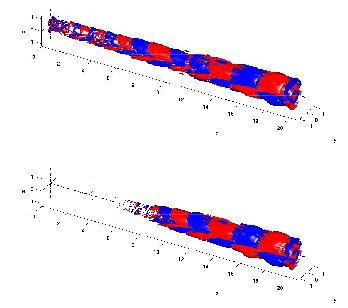
Légende de la figure : Représentation tri-dimensionnelle du mode le plus énergétique d'un jet excité à la buse par une excitation stochastique gaussienne. Deux iso-surfaces correspondant à deux valeurs opposées de la vorticité axiale sont repréentées. Figure du haut : résultat obtenu par la décomposition orthonale propre (POD) d'une simulation pleinement non-linéaire. Figure du bas : mode propre de la solution de l'équation de Lyapunov.
Jeudi 6 Mai 2010
14 h 00 salle de réunion LEA/SP2MI
Professor
California Institute of Technology
Invité par P. Jordan
We describe results from collaborative research aimed at developing closed-loop flow control to enhance aerodynamic forces and maneuverability of low aspect-ratio wings for micro air vehicles (MAV). Direct numerical simulations of the flow, based on a new implementation of the immersed boundary method, are used to investigate the flow and control strategies. Transient and steady-state results are validated by comparison with tow-tank experiments and performance is assessed as a function of aspect ratio and planform. The dynamics and interplay of the leading-edge and tip vortices at high angles of attack are highlighted. Actuation strategies are also assessed in the simulations; small amounts of forcing can result in significant increases in lift and lift-to-drag ratio. For two-dimensional model problems, closed-loop controllers have been designed based on reduced-order models or optimal control of the full simulations. Controllers are demonstrated that are capable of stabilizing unstable equilibrium solutions and of optimizing lift by adjusting (and locking) the phase between vortex shedding and actuation.
Mercredi 5 Mai 2010
14 h 00 salle de réunion LEA/SP2MI
Post-doc
School of Aeronautics
Universidad Politécnica de Madrid
Invité par P. Jordan
Laminar separation bubbles (LSB) are present in many industrial and aeronautical applications, including aircraft wings at high angles of attack, low-pressure-turbine and wind-turbine blades, and usually involve remarkable losses in performance, life-time of components or in-flight safety. In the classic LSB picture, separation of the boundary-layer occurs due to a strong enough adverse-pressure-gradient. The resulting separated shear-layer is highly unstable against Kelvin-Helmholtz waves so eventually the flow will undergo transition to turbulent regime and, finally, reattach. The local nature of the KH instability suggests that the Orr-Sommerfeld equation, based on the parallel-flow approximation, is able to provide all the relevant information on the instability characteristics of the bubbles. However, a linear modal instability analysis based on the full linearized Navier-Stokes equations, without resorting to the parallel-flow assumption (approach known as BiGlobal instability analysis) was used (Theofilis, Hein & Dallmann 2000) to discover a self-excited global eigenmode of the recirculation bubble.
The work of Theofilis, Hein & Dallmann (2000) serves as the point of departure of the present effort. First, the fundamentals of the BiGlobal instability theory, as well as novel numerical and computational methods are investigated. This methodology is applied to the problem of laminar separation bubbles on two configurations: a model LSB on a flat-plate and the massive separation on the lee-side of a stalled NACA 0015 airfoil. A theoretical reconstruction of the flowfields induced by the amplification of the global mode is done using critical-point concepts; it is shown that the self-excited mechanism exerts a steady tridimensionalization of the separated region, giving rise to two flow topologies observed experimentally: U-shaped separation and Stall Cells.
Mercredi 21 Avril 2010
11 h 00 salle de réunion LEA/SP2MI
Dept. of Mechanical and Manufacturing Engineering
Schulich School of Engineering
University of Calgary
Invité par J. Borée
For square-cross-section, vertically mounted cylinders placed in a thin boundary layer, the existence of two competing shedding modes in turbulent regime has been postulated since the late 70's. In one mode, the periodic shedding is alternating (anti-symmetric resembling a von Karman street) and, in the second, the vortices are shed in-phase (symmetric shedding). The supporting evidence has been taken largely from low Reynolds number visualisations and randomly sampled velocity fields. While this model offers some valuable insights, some difficulties remain in reconciling the instantaneous flow field with topological constraints.
In this work, the vortex formation and shedding process is investigated using hot-wire anemometry and high-frame rate PIV for a surface-surface mounted vertical cylinder of aspect ratio 4 placed in a thin boundary layer (0.16 of the obstacle height). Close inspection suggests that two modes do exist, but that in both modes result in an alternating vortex streets albeit of different spacing. In the high-amplitude mode, the formation region resembles the alternating process observed in two-dimensional cases. In the low-amplitude mode, co-existing vortices are observed in the formation region at all times and vortices are partially shed in the wake. It will be shown that these modes satisfactorily explain fluctuation phase distributions in the wake.
Jeudi 25 Mars 2010
14 h 00 salle de réunion LEA/SP2MI
Université de Lille Nord de France, USTL, F-59000 Lille
Laboratoire de Mécanique de Lille (LML), CNRS-UMR 8107, F-59655 Villeneuve d'Ascq, Cedex France
Invité par R. Manceau
La réduction de la traînée turbulente par dilution d'un polymère dans un solvant newtonien est un des phénomènes les plus spectaculaires de la mécanique des fluides. Bien que connu expérimentalement depuis une soixantaine d'années, et simulé numériquement depuis une quinzaine d'années, ce phénomène demeure un objet de controverse, les 2 grandes théories contradictoires de Lumley et De Gennes étant en effet également supportées (ou réfutées) par des faits expérimentaux et numériques.
On s'intéresse dans cet exposé à la simulation directe de la réduction de traînée en considérant l'écoulement turbulent tri-dimensionnel dans un canal plan d'une solution polymérique diluée. Les simulations sont réalisées sur une machine massivement parallèle (c-à-d possèdant N>1000 coeurs), à l'aide du code NNEWT_SOLVE développé ces 4 dernières années au LML. Ce code mixte MPI/OPENMP est de précision quasi-spectrale (mixte Fourier / différence finies compactes d'ordre 6). Il résout les équations de quantité de mouvement couplées avec les 6 équations du tenseur de conformation d'un polymère de type FENE-P.
La parallélisation massive de l'algorithme repose essentiellement sur une grille MPI bi-dimensionnelle qui scinde alternativement 2 des 3 directions de l'espace. Cette stratégie permet d'obtenir une bonne scalabilité jusqu'à 16K coeurs (1K = 1024 coeurs) et d'atteindre à la fois des nombres de Reynolds et des régimes de réduction de traînée jusqu'à présent inenvisageables. Ainsi, le cas le plus résolu jusqu'à présent (Retau=1000) est calculé sur un maillage comportant environ 1,3 milliards de noeuds, pour un régime de réduction de traînée très élevée de l'ordre de 60%.
L'exposé décrira l'algorithme utilisé, notamment les aspects de parallélisation, et fournira un aperçu de la base de données DNS en cours de construction.
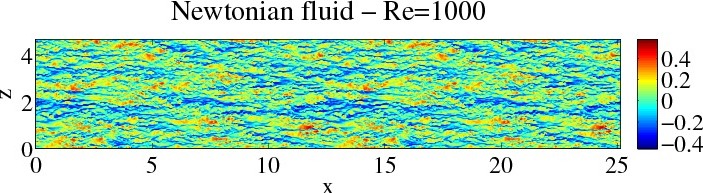
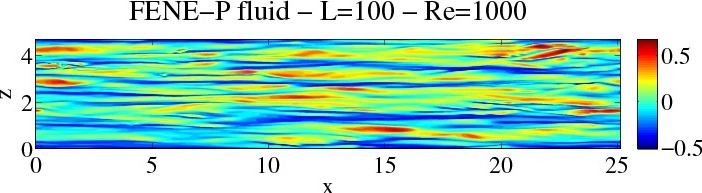
Légende des figures : Lignes d'émission ('streaklines') pour un nombre de Reynolds Retau =1000 à une distance y+=15 de la paroi. En haut, fluide newtonien; en bas, fluide viscoélastique. L'image du bas montre la destruction par le polymère des petites échelles turbulentes.
Laurent Cordier Dernière modification le 04/06/2010